
Countertops That Look Like Marble Without the Maintenance
Quartz countertop fabrication and installation in Portsmouth for Seacoast homes where pattern continuity and seam precision separate quality installations from visible mistakes
Seam placement on patterned engineered quartz determines whether the installation looks deliberate or reveals fabrication shortcuts. Renaissance Stone fabricates and installs quartz countertops for Seacoast New Hampshire kitchens with the seam planning that maintains pattern continuity across slab transitions. You avoid the visible breaks that occur when seams are placed arbitrarily without regard for the engineered stone's repeating design, a planning failure that devalues the entire installation in high-traffic kitchens from Newington to Rye.
Engineered quartz combines ground natural quartz with polymer resins to create a non-porous surface that requires no sealing and resists staining better than natural stone. The manufacturing process allows for consistent color and pattern throughout each slab, but poor seam placement disrupts that visual continuity on large countertop runs. Precise fabrication requires planning seam locations during templating so that pattern lines align across joints and transitions occur at natural visual breaks rather than in the middle of open counter spans.
Schedule a templating appointment to review seam placement options based on your kitchen layout and selected quartz pattern.
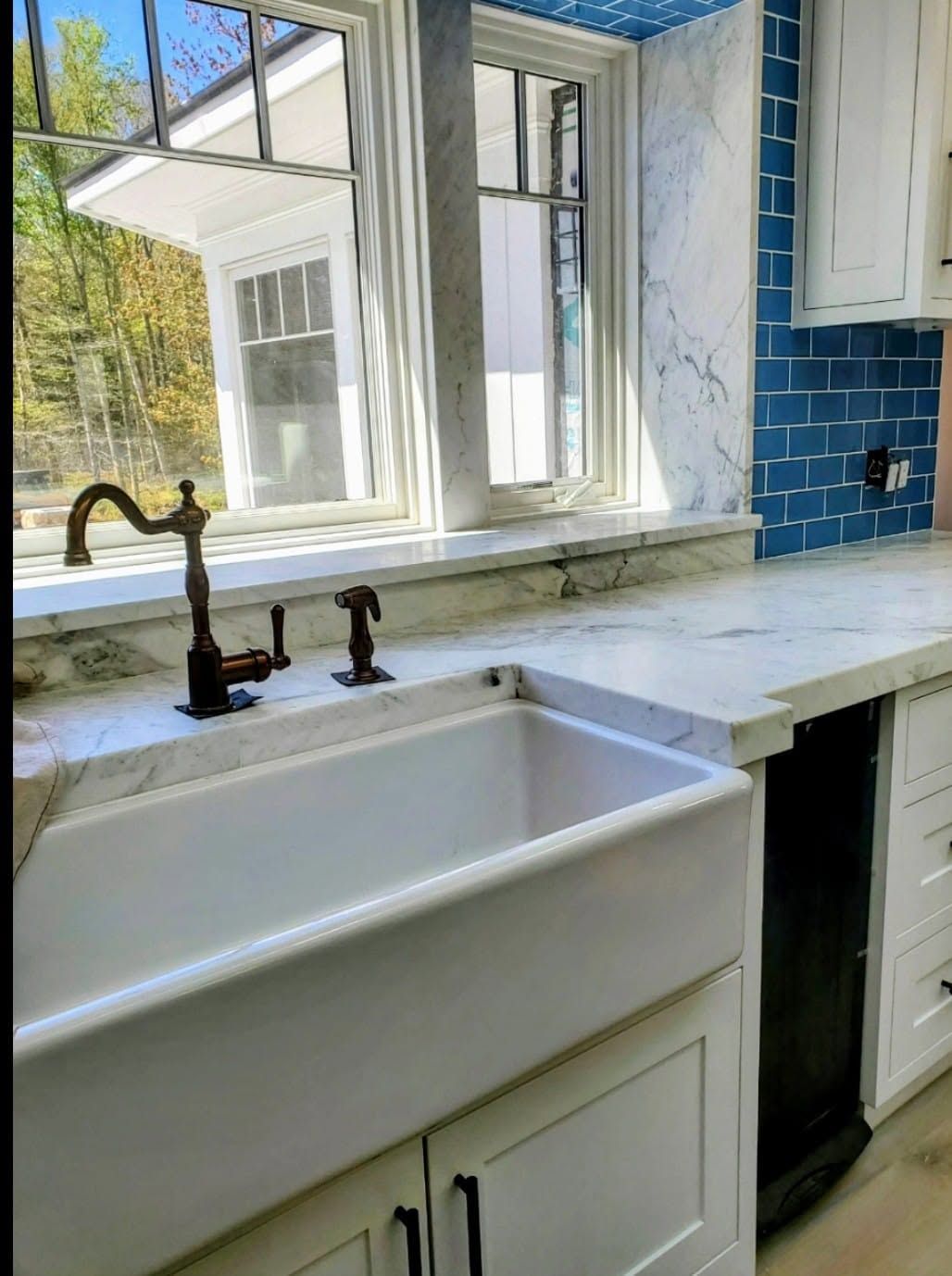
Why Seam Planning Matters on Patterned Slabs
Seams on engineered quartz are unavoidable when counter runs exceed slab dimensions, but placement decisions determine whether those seams disrupt the visual flow or integrate naturally into the design. Experienced fabricators position seams to follow pattern lines, occur near sinks or cooktops where they are less visible, or align with cabinet breaks where transitions appear intentional. The alternative is seams placed solely for fabrication convenience, creating mismatched pattern lines that draw attention to the joint rather than hiding it.
After installation, you notice quartz surfaces with consistent color and pattern across seams, edges that match the profile specified during planning, and a non-porous finish that sheds spills without staining. The surface resists scratching from normal kitchen use and tolerates most cleaning products without damage, though abrasive pads and bleach-based cleaners should still be avoided. Because quartz does not require sealing, the maintenance routine involves only daily cleaning with mild soap and water.
Engineered quartz is the preferred choice for families wanting low-maintenance kitchen surfaces, but not all quartz installations perform equally. Material quality varies by manufacturer, with higher quartz content producing more scratch-resistant surfaces. Edge profiles must be executed carefully because the resin binder can chip more easily than natural stone if edges are cut too thin or finished improperly.
What Homeowners Want to Know About Quartz
Engineered quartz dominates the Seacoast countertop market due to its low maintenance requirements and design consistency, but installation quality varies significantly between fabricators.
How is quartz different from quartzite?
Quartz is an engineered product made from ground natural quartz mixed with resins, while quartzite is a natural metamorphic stone. Engineered quartz is non-porous and requires no sealing, while quartzite requires periodic sealing like granite.
What makes seam placement a craft decision rather than just a technical one?
Seams positioned for structural convenience often disrupt pattern continuity and appear visually arbitrary, while seams planned around pattern lines and sightlines integrate into the design. The decision requires both fabrication skill and design awareness.
Does quartz perform well in Portsmouth's coastal environment?
Quartz's non-porous surface prevents moisture infiltration and resists the humidity and salt air common along the Seacoast without requiring sealing or special maintenance. The engineered composition eliminates the porosity issues that affect natural stone in coastal conditions.
Why do some quartz countertops show visible seams while others do not?
Seam visibility depends on placement location, pattern matching across the joint, and polish consistency at the seam edge. Poorly fabricated seams show lippage where one slab sits higher than the adjacent piece or fail to align pattern lines across the joint.
Can quartz be repaired if it chips or cracks?
Minor chips can be filled with color-matched epoxy by stone restoration professionals, but cracks typically require slab replacement because the resin binder does not bond structurally after curing. Preventing damage through proper support and careful installation is more practical than attempting repairs.
Renaissance Stone operates a locally owned fabrication shop in Portsmouth serving the full Seacoast region with engineered quartz installed to the precision standards that pattern-matched slabs demand. Request a slab selection consultation to review pattern options and discuss seam placement for your kitchen project.